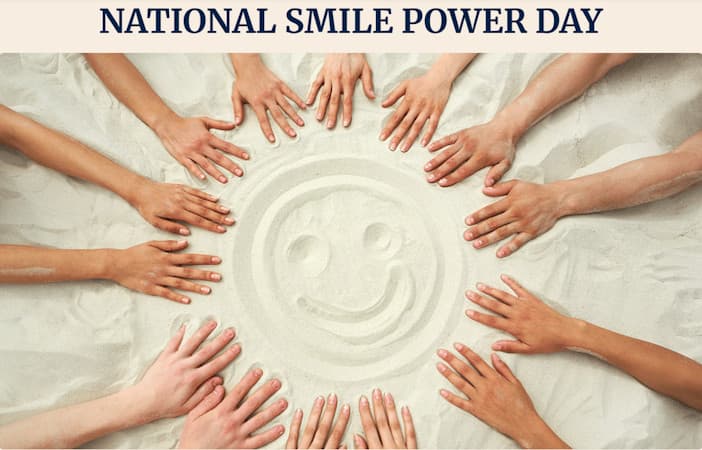
Smiling stimulates our brain's reward mechanisms in a way that even chocolate, a well-regarded pleasure inducer, cannot match.
On June 15th each year, National Smile Power Day shares one powerful expression.
From the good morning greeting and the first “How may I help you?” present yourself with a smile. No matter where you are employed, job seeking, retired, or looking for new horizons starting the day with a smile is certainly more empowering than a pout or grump. Starting with a smile first is easier than getting there later in the day.
- 1872 – Charles Darwin publishes “The Expression of the Emotions in Man and Animals,” arguing that smiles and other expressions are biologically based signals shaped by evolution rather than arbitrary social habits.
- 1963 – Harvey Ball creates the very popular and now familiar emoji of the yellow smiley face.
- 1971 – Psychologist Paul Ekman publishes research showing that people in Papua New Guinea and the United States reliably recognize facial expressions of happiness, supporting the idea that smiling is a near-universal signal of positive emotion.
- 1993 – Psychologists LaFrance, Hecht, and Paluck publish a meta-analysis indicating that women smile more often than men across many social situations, highlighting how smiling reflects social roles as well as inner feelings.
- 2000 – Harvey Ball declares the start of World Smile Day.
- 2001 – He passes away a few days after the first official day.
- 2009 – People worldwide started an online petition to make this day an official holiday.
- 2019 – A meta-analysis by Coles, Larsen, and Lench reports that adopting facial expressions such as smiling produces small but reliable shifts in felt emotion, lending measured support to the facial feedback hypothesis.
- When you smile at someone, you are telling them they are valued and worth the smile that you just gave them. Smiles are morale boosters and confidence builders.
- Research has shown that smiling increases attractiveness and likability in humans.
- Smiling creates greater trust and increased interpersonal cooperation.
- Smiling at someone can help them to relax and relieve their stress while at the same time, it will make you feel right.
- Even if you do not feel like it, smiling will lift your mood and can make you a happier person.
- Smiling is more contagious than the flu! It can’t be resisted.
- Smiling is our first facial expression.
- Babies are born with the ability to smile
- It’s easier to smile than it is to frown.
- Smiling reduces blood pressure.
- Employers promote people who smile often (Smiling in the workplace)
- Smiling makes you look successful.
- Smiling reduces stress
- There are 20 different types of smiles
- Smiling can help you live longer
- Smiling uses 5-53 muscles
- Humans can detect smiles from more than 300 feet away!
- Smiling releases endorphins
- If you are a woman, men find you more attractive when you smile
- The average woman smiles 62 times a day
- The average man smiles 8 times a day
- 63% of women say they look best in photos where their teeth are showing
- We can usually tell the difference between a fake smile and a genuine one
- 47% of people notice your smile first
- We buy 14 million gallons of toothpaste each year
- Smiling while talking on the phone makes you sound friendly.
- Faking a smile will help you get in a better mood.
- Around 50% of people will smile back if you smile at them.
- Smiling is a painkiller and can boost your mood.
- People who smile consistently are more likely to have healthy marriages.
- People have difficulty frowning when they look at other smiling subjects.
- 48% of young adults have untagged themselves from a photo on Facebook because of their smile.
- Waiters who smile often while working are more likely to get a high tip!
- Smiling stimulates our brain’s reward mechanisms in a way that even chocolate, a well-regarded pleasure inducer, cannot match.
- Kids laugh around 400 times a day, while the average is just 14 for adults!
- Great Apes such as chimpanzees, bonobos, orangutans, and gorillas love to laugh when play-wrestling, chasing, or tickling!
- Rats. Adorable fact: rats laughing sound like a “chirping” noise!
- Dogs. It may sound like a pant to us, but it’s a giggle to them!
- Dolphins. Dolphins’ laughs end with a whistle.
Sources:
National Today
The post by SouthFloridaReporter.com appears on South Florida Reporter.
VIP Journal Media
Need Premium Media Services?
Web Design
Brand Identity
Print Production
Explore Our ServicesTrusted by South Florida's leading brands