At the Florida summit, President Trump forged a 17-nation coalition to militarily eradicate cartels and warned Cuba's regime.
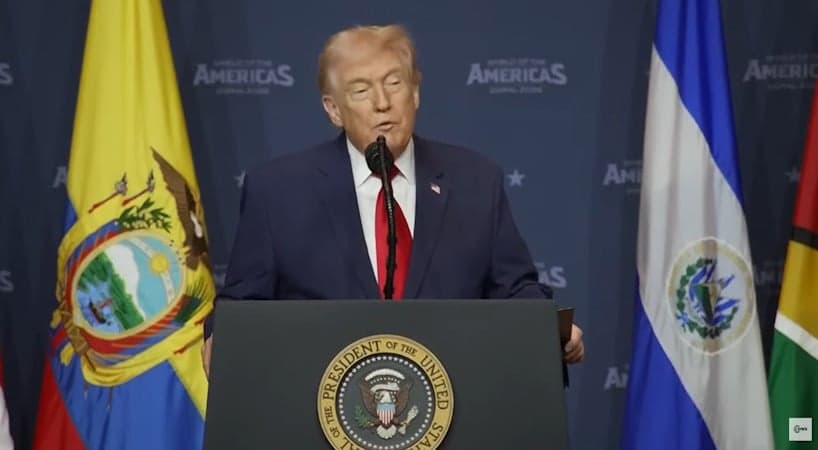
On March 7, 2026, the landscape of Western Hemispheric diplomacy shifted from the halls of traditional bureaucracy to the manicured greens of the Trump National Doral Miami. President Donald Trump, flanked by a phalanx of ideologically aligned Latin American and Caribbean leaders, unveiled the “Shield of the Americas”—a muscular, military-first framework designed to dismantle transnational criminal organizations and tighten the noose around the region’s remaining communist outposts.
The centerpiece of the summit was the formal signing of a proclamation establishing the Americas Counter-Cartel Coalition (ACCC). This 17-nation alliance signals a departure from decades of law-enforcement-led drug interdiction, pivoting instead toward what Trump described as “lethal military force” to solve the region’s security crises.
The War on the “Cancer” of Cartels
Addressing the assembled heads of state—including Argentina’s Javier Milei, El Salvador’s Nayib Bukele, and Ecuador’s Daniel Noboa—Trump was characteristically blunt about the threat posed by organized crime. He labeled the cartels a “cancer” that has grown more powerful than the sovereign militaries of some nations.
“The only way to defeat these enemies is by unleashing the power of our military. So we have to use our military. You have to use your military,” Trump told the audience. He argued that traditional police forces are often outgunned, intimidated, or corrupted by the vast wealth of narcoterrorist networks.
To back this rhetoric, the President made a startling offer: the use of American missile technology. “We’ll use missiles. You want us to use a missile? They’re extremely accurate,” Trump said, suggesting that the U.S. is prepared to provide surgical strike capabilities to allies willing to target cartel kingpins and infrastructure directly. This “military-first” approach is already being tested; just weeks prior, the U.S. and Ecuador announced joint operations that have moved beyond intelligence sharing into active, aggressive combat maneuvers.
The “Donroe Doctrine” and the Fall of Cuba
While the cartels were the immediate tactical focus, the broader strategic theme of the summit was the reassertion of U.S. hegemony under what has been dubbed the “Donroe Doctrine”—a 21st-century evolution of the Monroe Doctrine. This policy seeks to exclude “hostile foreign influence,” specifically targeting Chinese economic encroachment and the persistence of communist regimes.
Trump turned his sights specifically toward Havana. Following the recent U.S. military operation that resulted in the capture of Venezuela’s Nicolás Maduro, the administration has pivoted toward a “maximum pressure” campaign against the Cuban government.
“Great change will soon be coming to Cuba,” Trump predicted, asserting that the island nation is “at the end of the line.” Deprived of Venezuelan oil and facing a tightened U.S. blockade, the Cuban regime is, according to Trump, in its “last moments of life.” While he suggested the U.S. might be open to a “deal” with Havana, the underlying message was clear: the era of tolerance for the communist outpost is over.
A Coalition of the Willing (and the Absent)
The “Shield of the Americas” summit served as a litmus test for regional loyalty. The guest list was a “who’s who” of the Latin American right:
- Javier Milei (Argentina): A staunch ally who has pivoted Argentina’s foreign policy toward a full embrace of Washington.
- Nayib Bukele (El Salvador): Whose “Iron Fist” approach to gangs has become a blueprint for Trump’s regional security vision.
- Daniel Noboa (Ecuador): Currently overseeing a state of “internal armed conflict” against gangs with U.S. support.
Notably absent, however, were the leaders of the region’s largest economies: Mexico and Brazil. Trump did not mince words regarding Mexico, calling it the “epicenter of cartel violence” and claiming that “the cartels are running Mexico.” While he offered backhanded praise for President Claudia Sheinbaum’s recent military deployments, he warned that the U.S. would do “whatever is necessary” to protect its borders if Mexico cannot contain the chaos.
The Geopolitical Context
The Doral summit took place against a backdrop of global volatility. Even as Trump addressed the Latin American leaders, his attention was split; he departed the summit early for Dover Air Force Base to honor U.S. troops killed in the Middle East amid ongoing hostilities with Iran.
The administration’s “Shield of the Americas” is more than a drug-fighting pact; it is an attempt to create a secure, pro-Washington bloc that provides a “dangerous gateway” against foreign adversaries. Secretary of State Marco Rubio underscored this during a working lunch, telling the leaders, “They’re more than allies. They’re friends.”
By leveraging military assets and intelligence in a way not seen since the Cold War, the Trump administration is betting that a hardline security guarantee will prove more attractive to Latin American leaders than Chinese investment. For those in the room, the promise was clear: security and prosperity in exchange for a total alignment with American interests.
Sources and Links
- Trump Launches 17-Nation Counter Cartel Coalition at Shield of the Americas Summit – Homeland Security Today
- ‘They’re cancer’: Trump threatens cartels, Cuba at Latin American summit – Al Jazeera
- Trump encourages Latin American leaders to use military action to help U.S. fight cartels – PBS News
- Trump convenes ‘Shield of Americas’ summit with 12 Latin American leaders – The Guardian
- The Shield of Americas Gathering and an Amplified Strategy to Counter China – CSIS
- Trump offers missile support to Latin American leaders to target drug cartels – The Times of Israel
The post by SouthFloridaReporter.com appears on South Florida Reporter.
VIP Journal Media