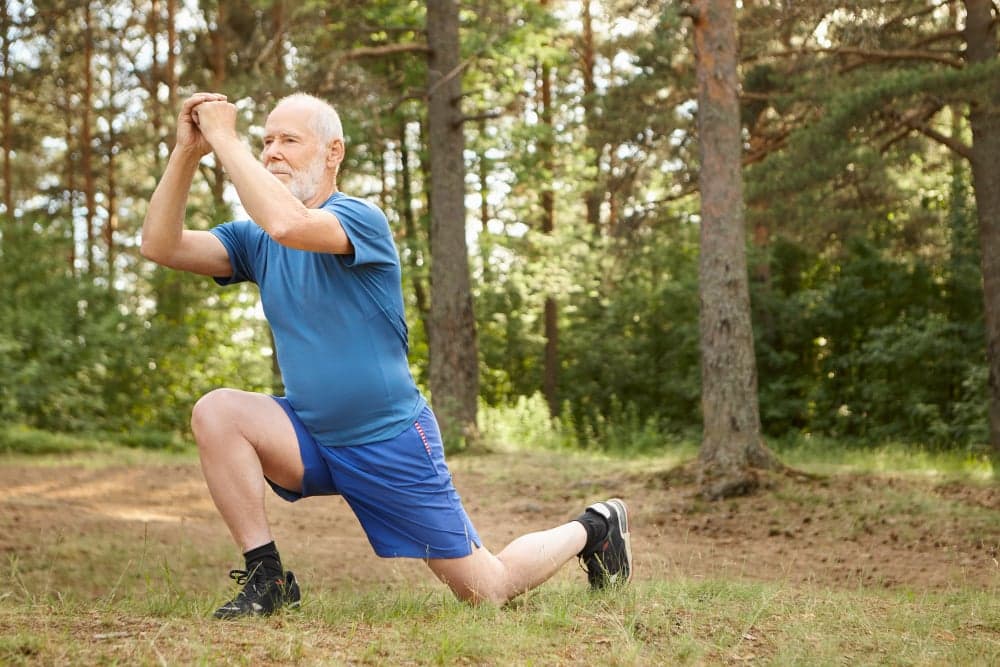
Even simple activities you can do on your own, such as climbing stairs, can build strength and coordination.
Mobility predicts how well you are aging through strength, balance, and coordination. Four simple at-home tests can reveal your aging health.
1. Timed Up and Go (TUG)
This test assesses mobility, balance, and fall risk. Studies suggest it can predict mortality.
For instance, a 2017 study found that slower TUG times were linked to a higher risk of death from any cause within 12 years in about a thousand adults aged 65 and older.
How to perform:
- Grab a stopwatch.
- Sit back in a standard armchair.
- Identify a line 10 feet away on the floor.
- Start the stopwatch.
- Stand up and walk to the line on the floor at your normal pace.
- Turn around.
- Walk back to the chair at your normal pace.
- Sit down again.
- Stop the stopwatch.
Taking 12 seconds or more to complete the test may indicate an increased risk of falling.
2. Standing on a Single Leg
Standing on one leg may seem simple, but it reveals crucial information about your balance and overall fitness.
A 2022 study found that adults aged 50 and older who cannot stand on one leg for 10 seconds may face a two-fold increased risk of death within the next decade.
How to perform:
- Stand with your feet together and your hands at your sides.
- Lift one foot off the ground, keeping it slightly bent at the knee.
- Start a timer (or have someone time you).
- Hold that position for 10 seconds while looking straight ahead.
3. Sitting-Rising
One reliable way to test balance, strength, and range of motion—the extent to which a body part can move freely—is the sitting-rising test. It gauges how well you can sit down on the floor and rise back up without assistance.
How to perform:
- Stand barefoot on a non-slip surface, such as a thin mat.
- Without worrying about speed, try to sit on the floor using as little assistance as possible.
- From the seated position, rise back up to standing—again, using the least amount of assistance needed.
To determine your score, start with a maximum of five points for sitting and five for rising. Deduct one point if you use any body part, such as a knee or hand, for support.
Any unsteadiness or loss of balance during the test knocks off a half point (crossing your legs at any point is fine, as long as you do not use the sides of your feet for support).
A 2025 study found that middle-aged and older adults who scored below 7.5 had a significantly higher risk of dying from natural causes within 12 years compared to those who scored a perfect 10.
4. 30-Second Chair Stand
This assessment measures lower-body strength and endurance, and it can help identify adults at risk of falling.
It may also be predictive of mortality. Research has found that performing fewer than four stands in 30 seconds is linked to a threefold increase in risk of death among people with chronic obstructive pulmonary disease (COPD).
How to perform:
- Set a stopwatch for 30 seconds, or have a friend time you.
- Sit in the middle of a chair.
- Cross your arms and place your hands on opposite shoulders.
- Keep your feet flat on the floor, your back straight, and your arms against your chest.
- Begin timing.
- Rise to a full standing position, then sit back down again.
- Repeat as many times as you can within 30 seconds.
A below-average score may indicate a heightened risk of falling. For those aged 60-64, the average score is 14 for men and 12 for women.
What To Do if These Tests Are Too Challenging
If you are struggling with these tests, do not panic. Instead, use it as a wake-up call to make some changes.
Bring your test results to your primary care physician rather than risking an injury.
“A fall can result in a huge change in a person’s life and something we in geriatrics fear tremendously,” Colleen Christmas, MD, a physician in geriatric medicine at Johns Hopkins School of Medicine, told Health.
The “great news is that many of the factors that contribute to a high risk of falls are fixable,” said Dr. Christmas.
What’s key is a consistent exercise routine that focuses on building strength, mobility, and balance.
Work with a trainer or physical therapist, or participate in exercise classes catered to your age group. Even simple activities you can do on your own, such as climbing stairs, can build strength and coordination.
“The benefits of exercise cannot be overstated,” said Dr. Christmas.
The post by Health.com appears on South Florida Reporter.
Etiquetas
VIP Journal Media