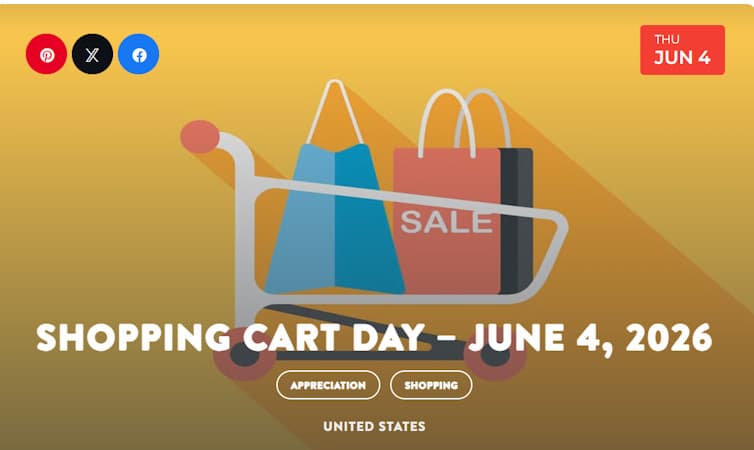
Inspired by a folding chair, supermarket owner Sylvan Goldman invented the first shopping cart in 1937 to help customers shop.
Shopping Cart Day on June 4 calls for a celebration of the baskets on wheels we use to journey through the aisles in a supermarket. The inventor of shopping carts wanted to increase the time customers spent in a supermarket to maximize the overall profitability rates by expanding the medium to temporarily carry items in-store.
The initial designs included baskets and carriage capacity factors. Many other points related to push-pull ease, wheel rotation, and material heaviness also had to be considered.
- 1750 BC – The first customer service complaint was in Mesopotamia 4,000 years ago (1750 BC) when a customer named Nanni complained about being sold inferior copper ingots.
- 1937 – Sylvan Goldman, the owner of the Humpty Dumpty supermarket chain, invents the first shopping cart, calling it the folding basket carrier.
- Goldman was inspired by a folding chair. He placed a wire basket on the folding chair and wheeled it around his office to assess its efficacy.
- 1940 – Shopping carts became popular, all thanks to peer pressure. Goldman hired saleswomen to offer shopping carts to incoming customers at the entrance. When they refused to take a cart, the saleswomen would ask them why, since everyone else in the supermarket was using one. The ‘everyone else’ she was referring to were hired models who pretended to shop. In the end, the reluctant customers would be convinced to take the carts.
- 1946 – Kansas City inventor Orla E. Watson designs a new “telescope” shopping cart whose baskets slide into one another, allowing carts to nest compactly in lines and reducing storage space.
- 1947 – Goldman adds a child seat to his shopping carts, solving many customers’ concerns about pushing a pram and a cart at the same time.
- 1949 – Orla Watson files his key U.S. patent for the telescoping shopping cart, securing commercial adoption of the nesting system that becomes the norm in grocery and big-box retailers.
- 1950s – Then, in the 1950s, the shopping cart we all know and love – the one with a big basket – was introduced.
- 1960s – Since the 1960s, when seatbelts were added to the child seat, the design of the shopping cart has not changed much.
- 1990s – Retailers begin replacing all-metal carts with lighter plastic-basket or plastic-frame models that resist rust, protect car finishes, and accept branding and color customization.
- 2000s – Stores and tech companies experiment with barcode scanners, weight sensors, and, later, RFID in shopping carts, allowing customers to scan items as they go and speeding up checkout.
- 2012 – Chaotic Moon Labs invented a driverless shopping cart for indoor use, and it is called ‘Project Sk8’.
- A study at Brigham Young University stated that if you didn’t want to spend too much money while shopping, you should do so while wearing high heels.
- There are more shopping malls in America than there are schools.
- There is no single correct term for a shopping cart, as the name varies by region. In America, it is called a shopping cart, but in Britain it is called a trolley.
- Shopping Facts:
- During the late 1800s, you could purchase divorce papers through a vending machine for $2.50 in Utah.
- Here are some shopping cart songs:
- Shopping Carts by J. Monty (2019)
- Lost in the Supermarket by The Clash (1979)
- Shopping Trolley by Beth Orton (2006)
- Shopping Bags by De La Soul (2004)
- Carts generally cost between $100 and $150 each.
- Almost every major city has one or more companies whose sole business is to retrieve and return abandoned carts to their rightful owners for a small fee.
- The American Academy of Pediatrics (AAP) reported that 20,700 kids under 5 years old were treated in hospital emergency rooms for shopping cart-related accidents in 2005. About 75% of these injuries were to the head or neck with about 85% occurring after a kid fell out of the cart or caused the cart to tip over.
- With the exception of the automobile, the shopping cart is the most commonly used “vehicle” in the world: some 25 million are at grocery stores across the U.S. alone (according to priceonomics.com).
- Carts typically last about 10 years.
- Want to cut down on your consumption of junk food? Avoid using a basket. As it turns out, the strain that a basket makes on your arm is more likely to get you searching for the instant gratification of a Snickers bar (via Time).
Sources:
The post by SouthFloridaReporter.com appears on South Florida Reporter.
Etiquetas
VIP Journal Media
¿Necesita Servicios de Medios Premium?
Diseño Web
Identidad de Marca
Producción Impresa
Explorar Nuestros ServiciosLa confianza de las marcas líderes del Sur de Florida