Benjamin Netanyahu claims Israel created the permanent conditions for the eventual collapse of the brutal Iranian regime.
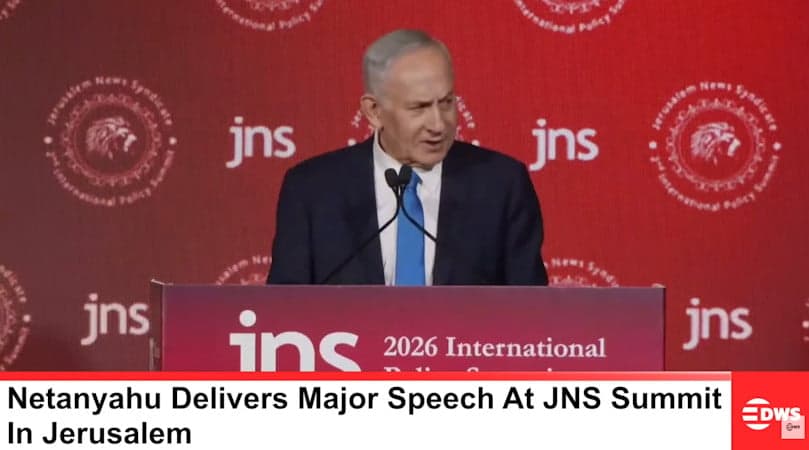
JERUSALEM — Speaking today at the JNS International Policy Summit, Prime Minister Benjamin Netanyahu vigorously defended Israel’s ongoing military posture, asserting that the country’s multi-front campaign has fundamentally fractured Iran’s regional architecture and created the permanent conditions necessary for the eventual collapse of the Islamic Republic.
The premier’s high-profile address comes at a highly sensitive diplomatic juncture, unfolding just as high-level, high-stakes negotiations between the United States and Iran continue in Switzerland under the shadow of a volatile regional environment. Netanyahu used the platform to issue a resolute declaration that no amount of international diplomacy would alter Israel’s core strategic defense objectives in either Tehran or southern Lebanon.
Laying the Groundwork for the Fall of Tehran
A central theme of Netanyahu’s address was the evaluation of Israel’s direct military campaign against Iran over the past year. While the premier had previously listed regime change as a strategic hope at the onset of the joint U.S.-Israeli campaign, he had largely refrained from declaring premature success, particularly after the Iranian government weathered a series of severe internal protests in January with a brutal crackdown.
Today, however, Netanyahu explicitly claimed that the systemic degradation of Iran’s sovereign capabilities has set a countdown for the ruling clerics.
“We decapitated the leadership of the terror regime; we shattered their missile industry; we knocked out their navy; we knocked out their air force; we attacked their military industries; we attacked their bridges,” Netanyahu told the summit.
The Prime Minister estimated that the economic and structural toll inflicted upon the Islamic Revolutionary Guard Corps (IRGC) is “counted in hundreds and hundreds of billions of dollars,” rendering the system fundamentally unstable.
“It will take them a long time to recover—and they may not recover,” Netanyahu continued. “Because once you deal these blows, and once the rift between the regime and the people is so deep, you cannot tell when such a regime will fall. And I think we created the conditions for its future fall.”
Netanyahu emphasized that while Israel’s military strikes shattered the regime’s defensive and offensive teeth, the final blow must come from within. He noted that the “real triumph” will be realized when the Iranian public takes destiny into its own hands to permanently dismantle the administrative apparatus that has terrorized both its domestic population and the broader global community.
Defending the Southern Lebanon Security Zone
Shifting his focus to Israel’s immediate northern border, Netanyahu addressed the highly contentious issue of Israel’s newly established security zone in southern Lebanon. The military buffer zone—instituted following extensive operations against the Iranian-backed militia Hezbollah—has drawn sharp criticism from U.S. President Donald Trump and Vice President JD Vance, particularly regarding noncombatant casualties during intense urban warfare.
Netanyahu firmly rejected foreign rebukes, framing the ongoing occupation of the southern Lebanese buffer zone as an elementary act of national survival that any sovereign state would execute under similar duress.
“As long as we need to protect our people, we will remain in the security zone in South Lebanon. And the reason is perfectly understood. No country would be asked to do otherwise,” Netanyahu stated, directly appealing to American historic precedent. “What would America do? Would it say, well, there’s nothing we can do? Let’s hold our fire? Is that what America would say? No! You know damn well what America would do. It would cross the border, create a security zone, kill the terrorists, and protect its people until the threat is removed. That’s exactly what we are doing.”
Addressing the friction regarding civilian casualties, Netanyahu argued that Israel’s combatant-to-civilian casualty ratio reflects an unprecedented standard of operational precision in modern urban warfare. Citing data compiled by the research arm of the Israeli Defense Ministry, Netanyahu asserted that while standard urban conflicts yield an eight-to-one ratio of noncombatant deaths, Israel’s operations in Lebanon have maintained a drastically lower margin.
“We should be commended for it, not condemned,” the Prime Minister stated. “We do everything in our power to protect our people. We don’t have a war with Lebanon. We have a war with Hezbollah, who terrorizes Lebanon and seeks our destruction.”
Defying the Switzerland Diplomatic Tracks
Netanyahu’s remarks served as an explicit message to international intermediaries, particularly those convening in Switzerland to finalize an interim pact intended to formalize an end to the active war. The ongoing diplomatic track has faced structural roadblocks, with Iranian state media reporting that negotiations have entered a “difficult phase” following provocative public warnings from President Trump.
A principal point of contention in Switzerland remains the status of Lebanon. Tehran has aggressively demanded that any sweeping diplomatic settlement include an immediate ceasefire in Lebanon and a total withdrawal of Israeli forces back to the international border. Concurrently, IRGC-affiliated outlets like the Tasnim News Agency have indicated that Iran may refuse to implement maritime agreements regarding the critical Strait of Hormuz unless Lebanese territorial sovereignty is restored.
Netanyahu explicitly decoupled Israel’s military movements from the outcomes of the Western diplomatic process. He reiterated a strict red line: under his leadership, Israel will never allow Iran to possess nuclear weapons, regardless of whatever temporary diplomatic frameworks are signed in Europe.
Furthermore, by affirming that the Israel Defense Forces (IDF) will remain stationed in southern Lebanon indefinitely, Netanyahu signaled to both Washington and Tehran that Israel will not consider itself bound by a U.S.-Iran agreement that compromises its cross-border security depth.
The Prime Minister concluded his address by framing the recent military campaigns as a permanent shift in Israel’s historical security doctrine—moving from localized containment to direct, unhindered military action against existential threats at their source.
Sources and Links:
- The Times of Israel: Netanyahu says Israel successfully ‘created the conditions’ for future fall of Iranian regime
- The Times of Israel: Defending Lebanon security zone, Netanyahu says US would do ‘exactly’ the same if threatened
- Iran International: Netanyahu says Israel will not yield on Iran nuclear program, Hezbollah
- JNS (Jewish News Syndicate): JNS.org Official Portal and Policy Summit Coverage
- Associated Press / WRAL: Trump threats shake up US-Iran talks in Switzerland on deal’s details
The post by SouthFloridaReporter.com appears on South Florida Reporter.
VIP Journal Media