A five-thousand square foot recessed entry court in Sherman Park will funnel tourists into a high-tech underground screening facility.
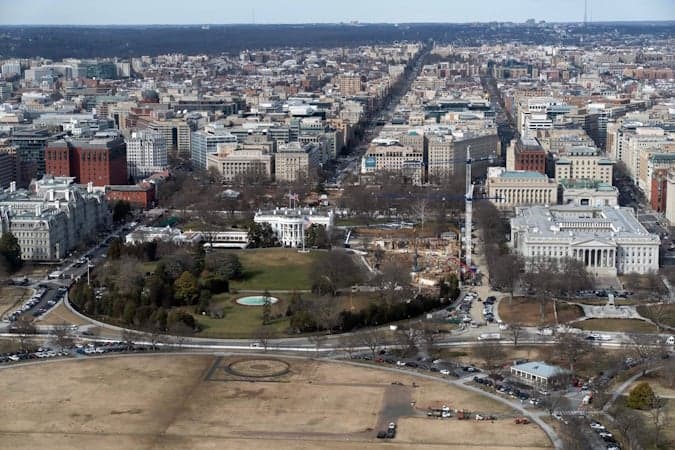
WASHINGTON — In a comprehensive overhaul of the White House’s public-facing infrastructure, the Trump administration has unveiled designs for a massive subterranean visitor complex. Central to this proposal is a 5,000-square-foot recessed plaza—an “entry court” that will serve as the primary arrival point for the public. This plaza is the focal point of a larger 33,000-square-foot underground security screening center designed to modernize the experience of visiting the Executive Mansion while dramatically enhancing security protocols.
The plans, submitted to the National Capital Planning Commission (NCPC) on March 13, 2026, propose locating this underground facility beneath Sherman Park, situated southeast of the White House and directly south of the Treasury Building. By moving the entry process underground, the administration aims to resolve decades of logistical and aesthetic issues plaguing the White House grounds.
The Recessed Entry Court: A New Front Door
The proposed recessed plaza is designed to act as a buffer between the public sidewalks of Washington, D.C., and the high-security environment of the White House. Currently, visitors often wait in long queues along 15th Street NW, exposed to the elements and clogging public thoroughfares.
The new plaza will be carved into the southern end of Sherman Park, allowing visitors to descend into a secure, semi-enclosed space before entering the screening lanes. This “entry court” serves several critical functions:
- Crowd Mitigation: It provides a dedicated space for visitors to gather and organize into groups away from street traffic.
- Aesthetic Preservation: By placing the primary screening entrance in a recessed court, the project eliminates the need for the “unsightly” temporary trailers and tents that have served as security checkpoints for years.
- Historic Integration: Architects have designed the plaza to ensure that the monument of Union General William Tecumseh Sherman, which sits in the center of the park, remains the primary visual landmark. The plaza and subterranean facility will be constructed around the monument’s deep foundations.
High-Volume Security Infrastructure
Once guests move from the recessed plaza into the 33,000-square-foot facility, they will encounter a state-of-the-art screening hall. The facility is planned to feature seven security lanes, a significant increase from current capacity. This expansion is specifically intended to “ease processing and reduce wait times,” which can currently exceed two hours during peak spring and summer tourist seasons.
The interior of the screening center is expected to mirror the neoclassical aesthetic of the White House itself, moving away from the purely utilitarian feel of current checkpoints. After clearing security, visitors will proceed through a secure underground corridor. This path will eventually lead them to emerge near the site of the new White House State Ballroom, a 90,000-square-foot structure currently being built on the former site of the East Wing.
Strategic Timing and Oversight
The project is a multi-agency collaboration between the Executive Office of the President, the U.S. Secret Service, and the National Park Service. According to the timeline submitted to the NCPC, construction is projected to begin as early as August 2026. The administration is pushing for a completion date of July 2028, ensuring the facility is fully operational six months before the end of President Trump’s current term.
While the subterranean plaza and screening center are framed as necessary security upgrades, they are part of a broader, more controversial transformation of the White House campus. The project has drawn scrutiny from the Society of Architectural Historians and members of Congress, who have expressed concern over the “piecemeal” revelation of these massive changes.
“The White House is the People’s House, a living symbol of democracy,” noted a letter from House Democrats to the National Park Service earlier this month. Critics argue that the scale of the underground excavation and the associated ballroom project may bypass traditional environmental and historic preservation reviews.
The NCPC is scheduled to hold a formal discussion and take potential action on these plans during its meeting on April 2, 2026.
Sources and Links
- WFTV 9: The White House wants to build an underground center to provide security screening for visitors
- Associated Press via SeattlePI: White House plans for 33,000-square-foot subterranean center
- National Capital Planning Commission (NCPC): East Wing Modernization Project – Project Narrative March 2026
- House Committee on Natural Resources: 2026-03-04 RM Huffman Letter to NPS re White House Ballroom
- National Park Service (NPS): White House East Wing Modernization and State Ballroom Project Home
- KSAT: Renderings of White House underground center included in federal agenda
The post by SouthFloridaReporter.com appears on South Florida Reporter.
VIP Journal Media