A Delivery Like No Other: McDonald’s in the Oval Office On a breezy Monday afternoon, April 13, 2026, the heavy gates of the White House opened for a silver sedan driven by 70-year-old Sharon Simmons.
A Delivery Like No Other: McDonald’s in the Oval Office
On a breezy Monday afternoon, April 13, 2026, the heavy gates of the White House opened for a silver sedan driven by 70-year-old Sharon Simmons. Known to her local community in Northern Virginia as the “DoorDash Grandma,” Simmons wasn’t there for a tour; she was there to fulfill an order of two Quarter Pounders with Cheese, a Filet-O-Fish, and several large fries.
President Donald Trump met Simmons at the door of the Oval Office, a scene that immediately went viral across social media. The President, wearing his signature red tie, appeared in high spirits despite the mounting pressure of a global energy crisis. “This is the best-looking delivery I’ve seen in a long time,” Trump remarked as he took the bags. “Sharon, you’re a star. Everyone is talking about you.”
Simmons, who began dashing to help cover her husband’s rising medical costs, didn’t shy away from the spotlight. “Mr. President, I just want to say thank you for the ‘No Tax on Tips’ law,” she said, referring to the landmark legislation passed earlier in the term. “It’s put an extra $11,000 in my pocket this year. That’s more than just money; that’s peace of mind for my family.”
The President used the moment to pivot to his economic platform, emphasizing that the “One, Big Beautiful Bill” was designed specifically for people like Simmons. “The radical left wanted to tax her into poverty,” Trump told the gathered press. “We said no. We said if you work hard and you’re serving people, you keep what you earn. Sharon is the backbone of this country.”
The Blockade: “Peace Through Strength” at the Strait of Hormuz
While the atmosphere inside the White House was one of casual populism, the situation 7,000 miles away in the Persian Gulf was anything but lighthearted. At 10:00 AM ET that same morning, the United States officially implemented a naval blockade of the Strait of Hormuz.
The objective is clear: to halt the “illegal enrichment” of the Iranian regime by intercepting any vessel attempting to pay transit fees to Tehran. President Trump, between bites of his Filet-O-Fish, addressed the escalating tension with characteristic bluntness.
“We are not looking for war, but we are also not going to be robbed,” Trump stated. “Iran has been taking billions in ‘protection money’ from every ship that passes through that water. Those days are over. The blockade stays until they realize that the United States is back in charge of global security.”
Despite the aggressive posture, the President hinted that a diplomatic off-ramp remains possible. He confirmed reports that Tehran had reached out through intermediaries to discuss a “Grand Bargain.”
“They’d like to make a deal very badly,” Trump claimed. “They’re feeling the squeeze. They see the ships, they see the power, and they know I’m not playing games. We can talk, but the blockade won’t budge until the enrichment stops and the threats end. We’ll see what happens.”
The “Holy Source” and the Divine Image
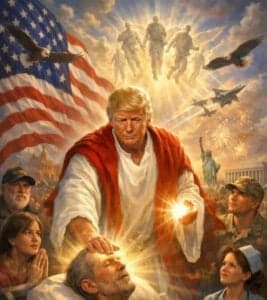
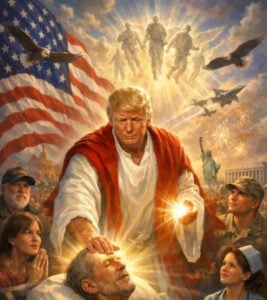 The conversation took a surreal turn when a reporter asked the President about a viral AI-generated image circulating on Truth Social and X. The image depicts President Trump in celestial robes, surrounded by light and ancient scrolls, and is often called the “Holy Source” or “The Protector.”
The President laughed, but his response carried a note of appreciation for the sentiment. “It’s a very beautiful picture,” Trump said. “I don’t know about the ‘God’ part—I’m a very humble person, maybe the most humble person you’ve ever met—but I think people see me as a protector. They see the chaos in the world, the wars, the high prices, and they look at that image and see someone who can bring order. It’s about strength. People want a leader who looks like he can handle the weight of the world.”
The image has sparked a firestorm of debate between secular critics and the President’s more devout supporters, with some religious leaders expressing concern over the “messianic” overtones. However, the President dismissed the controversy, focusing instead on the “artistry” and the message of hope it conveys to his base.
Invoking Pope Leo: The Moral Economy
In a surprising intellectual turn, the President referenced Pope Leo XIII, specifically citing the 19th-century pontiff’s teachings on the rights of labor and the dignity of the working class.
“I was reading about Pope Leo,” Trump noted, likely referring to Rerum Novarum. “He understood that you can’t have a great country if the workers are being destroyed. He talked about the ‘misery and wretchedness’ of the working class back then. Well, we’re fixing that. Whether it’s ‘No Tax on Tips’ or bringing the factories back from China, we are following that path of making sure the person doing the work—like Sharon here—is respected by the government.”
The invocation of Pope Leo is seen by analysts as an attempt to further solidify the President’s “blue-collar” Catholic vote, particularly in swing states like Pennsylvania and Michigan, by framing his economic policies as a moral imperative rather than just fiscal strategy.
The Pain at the Pump: A Forecast for the Midterms
The most immediate impact of the blockade, however, is being felt by American drivers. Gas prices have surged, with the national average hitting $4.16 per gallon and oil flirting with the $100-per-barrel mark.
The President was candid about the economic turbulence. “Look, when you stand up to bullies, sometimes there’s a cost,” Trump admitted. “Gas prices might stay high for a while. They might stay high through the November elections. But I’d rather have a slightly higher price at the pump now than a nuclear Iran later. We’re going to open up the pipelines, we’re going to ‘drill, baby, drill,’ and we’ll bring it down. But right now, we’re in a fight for the future of the world’s energy.”
Critics argue that the blockade is a self-inflicted wound that could jeopardize the Republican majority in the upcoming midterms. Senator Mark Warner (D-VA) warned that the move could trigger a global recession, stating, “You cannot blockade the world’s most important oil artery and expect the economy to remain stable.”
A Long-Term Project
As the “DoorDash Grandma” finished her visit and headed back to her silver sedan, the President returned to the maps in the Oval Office. The blockade of the Strait of Hormuz is, in the words of administration officials, a “long-term project.” It is a high-stakes gamble that leverages American naval supremacy against a volatile global market.
Between the fast-food deliveries, the AI-generated divinity, and the historical references to 19th-century popes, the Trump presidency in 2026 remains a blend of the populist, the pugnacious, and the unpredictable. Whether this “Grand Bargain” with Iran will manifest—and whether the American consumer can withstand $4.00 gas—remains the defining question of the year.
Sources Used and Links:
- PBS NewsHour: WATCH: Trump speaks about ‘no tax on tips’ with a ‘DoorDash grandma’
- Washington Examiner: Trump gets McDonalds delivered by ‘DoorDash grandma’ to tout tax refunds
- The Guardian: Oil price tops $100 a barrel as US blockades strait of Hormuz; Goldman Sachs posts rise in profits – as it happened
- The Guardian: Oil price dips below $100 a barrel after Trump claims Iran wants deal
- Maaal News: Trump: Gasoline Prices Could Remain High Until Congressional Elections
- National Today / Miami Today: Trump Warns Gas Prices May Remain High Through Midterm Elections
- CBS News: Stocks edge up, oil hovers around $100 a barrel after U.S. begins partial blockade Strait of Hormuz
- Wikipedia: 2026 Strait of Hormuz crisis
- Vatican Archive: Rerum Novarum – Encyclical of Pope Leo XIII on Capital and Labor
The post by SouthFloridaReporter.com appears on South Florida Reporter.
VIP Journal Media