First Lady Mamie Eisenhower, a huge fudge fan., crafted her own recipe—named Mamie’s Million-Dollar Fudge. It included chopped nuts and marshmallow crème.
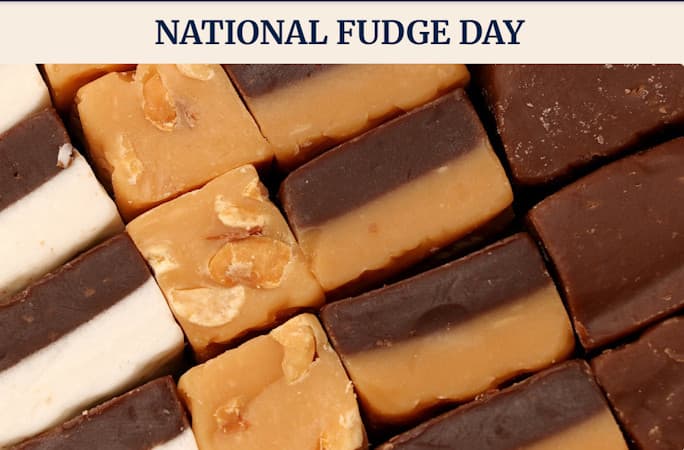
National Fudge Day is observed annually on June 16th. National Fudge Day is a food holiday that lets you indulge in your favorite fudge flavor. Some of the most familiar fudge flavors are chocolate, chocolate nut, peanut butter, maple and maple nut.
In the late 19th century, some shops on Mackinac Island, Michigan, began to produce similar products as the Vassar College fudge and sold it to summer vacationers. Fudge is still made in some of the original shops located on the famous island.
- 17th Century – The first recorded use of the word “fudge” is in the early 17th century. Its origin is probably an alteration of the obsolete fadge ‘to fit’. Early usage was as a verb in the sense ‘turn out as expected’ and ‘merge together’; this probably gave rise to its use in confectionery.
- 17th Century – In the late 17th century, the verb came to mean ‘fit together in a clumsy or underhand manner’, which included facts or figures being cobbled together in a superficially convincing way: this led to the exclamation ‘fudge!’ and the noun fudge.
- 1700s – The components of fudge are very similar to the traditional recipe for tablet, which is noted in The Household Book of Lady Grisell Baillie (1692-1733). The term “fudge” is often used in the United Kingdom for a softer variant of the tablet recipe.
- 1800s – Modern fudge recipes remain largely unchanged from the originals dating back more than 150 years.
- 1800s – Skuse’s Complete Confectioner was known as a guide for all things dessert—but the first editions of the book, printed in the late 1800s, didn’t include any recipes for fudge. In later editions, they made up for lost time, including recipes for rainbow fudge (food colorings), Mexican fudge (raisins, nuts, and coconut), maple fudge, and three types of chocolate fudge.
- 1886 – American-style fudge (containing chocolate) is found in a letter written by Emelyn Battersby Hartridge, a student at Vassar College in Poughkeepsie, New York, in 1886.
- 1886 – Fudge originates from a messed-up batch of caramels, hence the name
- 1886 – fudge was sold at a local Baltimore grocery store for 40 cents a pound. This is the first known sale of fudge.
- 1895 – A recipe for “Fudges at Vassar” was printed in The Sun in 1895.
- 1890s – By the late nineteenth century, students at Vassar, Wellesley, and Smith were sharing recipes and cooking fudge in dormitories, turning it into a social ritual and popularizing it beyond Baltimore.
- 1889 – The first fudge shop opens on Mackinac Island, Michigan.
- 20th Century – American candy makers begin widely selling chocolate, vanilla, maple, and nut fudge, promoting it as wholesome, square-cut confections distinct from penny candy and luxury bonbons.
- 1906 – The hot fudge sundae was created in Hollywood. C.C. Brown’s, an iconic ice cream parlor on Hollywood Boulevard, was credited for dreaming up the idea to drizzle melted fudge over ice cream in 1906 (earlier sundaes had other syrups, like cherry). Sadly, the shop closed in 1996, but the treat remains popular.
- 1955 – First Lady Mamie Eisenhower’s rich marshmallow cream fudge recipe, “Million-Dollar Fudge”, appears in a Women’s National Press Club cookbook and is reprinted widely, boosting the popularity of easy, stove-top chocolate fudge in U.S. homes.
- 2010 – The largest slab of fudge weighed 5,760 lb and was made by Northwest Fudge Factory in Levack, Ontario, Canada, on 23 October 2010.
- 2026 – Experience the magic of autumn at the newly reimagined Fall Fudge Festival on Mackinac Island, taking place October 2-3, 2026.
- Tablet definition: Tablet differs from fudge in that it has a brittle, grainy texture, whereas fudge is much softer. The well-made tablet is a medium-hard confection, not as soft as fudge, but not as hard as hard candy. Commercially available tablets often use fondant instead of milk products.
- Hot fudge in the United States and Canada is usually considered a chocolate product, often used as a topping for ice cream in a heated form, particularly for sundaes and parfaits.
- It is believed that someone was making caramel when they “fudged” up the recipe. The result was delicious, but the name stuck even as fudge grew in popularity.
- Another story goes that a college lecturer in Virginia was teaching a class in toffee-making, and the temperature was not heated high enough, resulting in what we now know as fudge.
- Fudge is not very nutritious, as it contains large amounts of sugar and a significant amount of fat, although it also contains small amounts of manganese and other vitamins and minerals.
- Fudge is commonly presented and sold in the shape of a rectangular block, and is usually available at market stalls or specialty confectionery stores.
- First Lady Mamie Eisenhower was a huge fudge fan. She even crafted her own recipe—named Mamie’s Million-Dollar Fudge—which her husband, Ike, quite liked. It included chopped nuts and marshmallow crème.
- As we know, copper kettles are great conductors of heat. That is why copper kettles are usually used to make fudge. It also belongs to the old way to make fudge.
- While the classic chocolate fudge remains a perennial favorite, the world of fudge boasts hundreds of variations. From peanut butter and maple to red velvet and even savory bacon fudge, the possibilities are vast, reflecting regional tastes and creative confectionery.
Sources:
Just Fun Facts
VIP Journal Media
Нужны Премиум Медиа-услуги?
Веб-дизайн
Идентичность Бренда
Печатное Производство
Смотреть УслугиНам доверяют ведущие бренды Южной Флориды