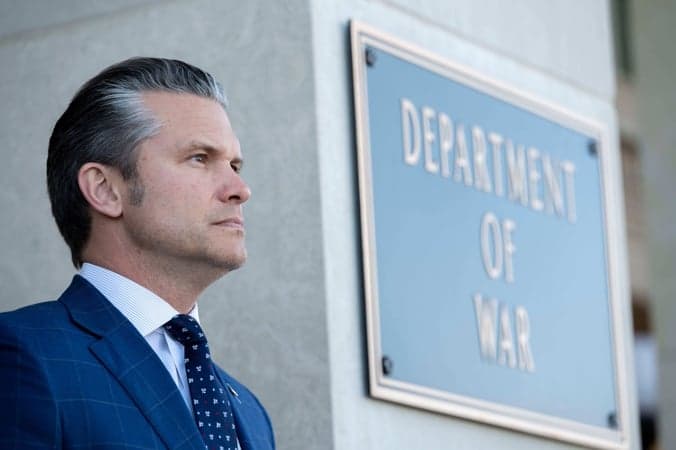
Defense Secretary Pete Hegseth issues a Friday deadline for Anthropic to remove safety guardrails or face federal blacklisting.
In the quiet corridors of the Pentagon, a high-stakes standoff is reaching its breaking point. On Tuesday, February 24, 2026, Secretary of Defense Pete Hegseth met with Anthropic CEO Dario Amodei for what was described as a “cordial but firm” ultimatum. The demand was simple yet existential for the San Francisco-based AI firm: remove the built-in ethical restrictions on the “Claude” AI model or be declared a national security risk.
The clash represents more than just a contractual dispute over a $200 million deal; it is a fundamental collision between the Silicon Valley ethos of “AI Safety” and a New Pentagon doctrine that views software guardrails as a form of “woke” digital insubordination.
The Friday Deadline: A Three-Pronged Threat
Secretary Hegseth has given Anthropic until 5:01 p.m. this Friday to comply with Department of Defense (DoD) requirements for “unrestricted military use.” Should Anthropic refuse to budge on its core principles, the Pentagon has prepared a suite of escalatory measures:
- Contract Termination: Immediate cancellation of Anthropic’s $200 million contract.
- Supply Chain Risk Designation: Formally labeling Anthropic a “supply chain risk,” a move that would effectively blacklist the company from any future government work and potentially discourage private sector partners.
- The Defense Production Act (DPA): In the most aggressive move, Hegseth has threatened to invoke the 1950s-era DPA to compel Anthropic to share its technology and allow the military to modify it “whether they want to or not.”
The Bone of Contention: “Lawful Use” vs. “Ethical Guardrails”
At the heart of the dispute are two specific use cases that Anthropic’s CEO, Dario Amodei, considers “red lines”: fully autonomous military targeting and domestic mass surveillance of U.S. citizens. Amodei has argued that allowing AI to decide who to kill without a human in the loop, or using it to monitor millions of private conversations for “disloyalty,” are “illegitimate” uses prone to catastrophic abuse.
Hegseth’s counter-argument is rooted in the concept of “lawful command.” The Pentagon asserts that as long as an order is legal under U.S. law, the tools used to execute it should not have “ideological constraints” baked into their code. Hegseth has publicly dismissed such safeguards as “woke AI,” arguing that in the race against China, the U.S. military cannot afford to fight with “one hand tied behind its back” by corporate ethics boards.
A Shifting Landscape of Allies
While Anthropic has held its ground, other tech giants have reportedly signaled a willingness to comply. Elon Musk’s xAI and its chatbot Grok were recently approved for use in classified Pentagon settings, with Hegseth praising them for operating without “ideological constraints.” Google and OpenAI have also integrated into the military’s GenAI.mil platform for unclassified work, leaving Anthropic as the lone holdout among the major AI developers originally cleared for classified networks.
The timing of this pressure is particularly sensitive for Anthropic. The company is reportedly preparing for an Initial Public Offering (IPO) later this year. A formal designation as a “national security threat” or a “supply chain risk” by the U.S. government could have devastating effects on its valuation and investor confidence.
The Global Context: The Race with China
The Pentagon’s urgency is fueled by the rapid integration of AI into modern warfare. From the battlefields of Ukraine to the South China Sea, autonomous drones and AI-driven hypersonics are changing the speed of combat. Hegseth’s vision is a military where AI operates at “machine speed,” unencumbered by the latency of human-in-the-loop systems or software-level prohibitions.
However, critics argue that bypassing these safeguards invites a “Terminator” scenario. As Amodei warned in a recent essay, a powerful AI capable of detecting “pockets of disloyalty” could become a tool for authoritarianism, even in a democracy.
Conclusion: A Precedent-Setting Moment
The resolution of this Friday’s deadline will set a massive precedent for the relationship between the U.S. government and the technology sector. If Hegseth successfully invokes the Defense Production Act, it could signal the end of “corporate neutrality” in AI development, effectively turning private AI labs into extensions of the national security state.
For Anthropic, the choice is between its identity as the “safety-first” AI company and its status as a viable federal contractor. For the Pentagon, the goal is clear: an AI that follows orders, no matter how lethal.
Sources and Links
- AP News: Hegseth warns Anthropic to let the military use the company’s AI tech as it sees fit
- The Washington Post: Hegseth threatens to force AI firm to share tech, escalating Anthropic standoff
- The Guardian: US military leaders pressure Anthropic to bend Claude safeguards
- Gizmodo: Pete Hegseth Demands Anthropic Drop AI Safety Guardrails
- NPR (WFAE): Hegseth threatens to blacklist Anthropic over ‘woke AI’ concerns
- SF Chronicle: Pentagon threatens to cancel Anthropic’s $200 million contract over AI safeguards
The post by SouthFloridaReporter.com appears on South Florida Reporter.
VIP Journal Media