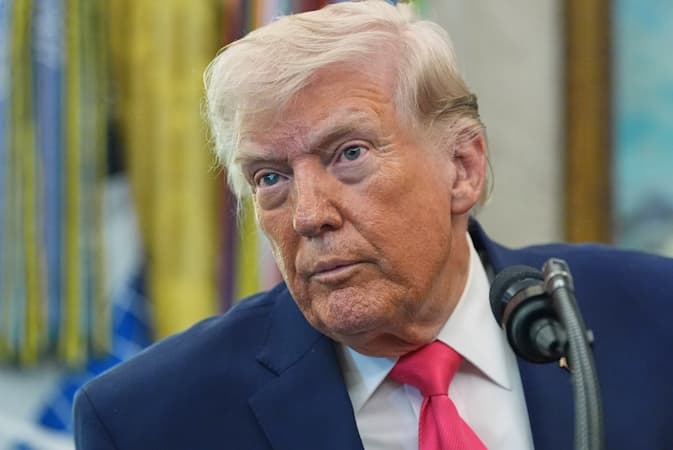
President Trump proposes record military spending funded by massive cuts to Medicaid, education, and essential federal social initiatives.
WASHINGTON, D.C. — On Friday, April 3, 2026, the White House formally unveiled a historic $1.5 trillion defense budget request for Fiscal Year 2027. This proposal, described by President Donald Trump as the necessary capital to build a “Dream Military,” represents the most aggressive shift in federal spending priorities since the Cold War. However, the staggering price tag is not merely a matter of military expansion; it signals a fundamental restructuring of the American government, as the administration proposes paying for this “Arsenal of Democracy” by gutting decades of domestic social programs.
While the administration frames the budget as a “peace through strength” imperative in the wake of the ongoing war in Iran, the fiscal reality has ignited a fierce national debate. By slashing non-defense discretionary (NDD) spending by as much as 23%, the President is forcing a choice between global military hegemony and the domestic welfare of the American people.
The Funding Strategy: “We Can’t Take Care of Day Care”
The central question surrounding the $1.5 trillion figure is one of solvency. With the national debt exceeding $39 trillion, the administration has rejected traditional deficit-neutral paths. Instead, the “Trump Doctrine” for the 2027 budget relies on a two-pronged strategy: aggressive domestic liquidation and the high-risk “Tariff Dividend.”
1. The Domestic Liquidation
At a private White House event on Wednesday, President Trump was blunt about the trade-offs:
“We’re fighting wars. We can’t take care of day care… It’s not possible for us to take care of day care, Medicaid, Medicare—all these individual things. They can do it on a state basis. You can’t do it on a federal.”
The budget proposal puts these words into action with deep, systemic cuts to the federal safety net:
- Department of Labor: A massive 35% cut, aimed at eliminating job training programs for dislocated, youth, and older workers.
- Department of Health and Human Services (HHS): A 26% reduction that critics warn will jeopardize research into cancer, dementia, and strokes, while gutting mental health services.
- Department of Education: A 15% cut as part of a long-term plan to dissolve federal oversight of schooling, shifting the financial burden entirely to states and local districts.
- Medicaid: Over $880 billion in projected cuts over the next decade, transforming the program into block grants for states.
- Refugee and Social Aid: The elimination of refugee resettlement programs and significant reductions in aid for low-income housing and energy assistance.
2. The Tariff Dividend Uncertainty
The President continues to insist that his sweeping tariff regime—taxing foreign imports to “rebuild the American factory”—will generate trillions to offset defense costs. However, this pillar of the funding plan is on shaky ground. Following a 2025 Supreme Court ruling that restricted the executive branch’s authority to impose broad tariffs under the International Emergency Economic Power Act (IEEPA), the projected revenue has plummeted.
While the administration recently modified tariffs on steel and aluminum to recoup roughly $70 billion, the Committee for a Responsible Federal Budget (CRFB) warns that even these gains are a “drop in the bucket” compared to the $1.5 trillion annual requirement. Without the full “Tariff Dividend,” the budget risks adding $6.9 trillion to the national debt over the next decade.
Where the Money Goes: The “Golden Dome” and Beyond
The $1.5 trillion is earmarked for a radical technological leap. The administration argues that the era of “incremental updates” is over, replaced by a mandate for “Absolute Dominance.”
The Golden Dome ($185 Billion)
The flagship of the budget is the “Golden Dome,” an AI-integrated missile shield designed to protect every inch of U.S. territory from hypersonic and ballistic threats. This project is seen as the “Great Wall” of the 21st century, intended to make the U.S. immune to nuclear or conventional missile blackmail.
The Golden Fleet and War Stocks ($305 Billion)
A significant portion of the surge is allocated to the Navy and the replenishment of munitions. The ongoing war in Iran has depleted the U.S. “depth of fire,” requiring a massive industrial ramp-up. The budget funds the construction of new Virginia-class submarines and a rapid expansion of the fleet toward a 525-ship goal.
Industrial Base Coercion
The budget is also a tool of industrial policy. Under a recent Executive Order, the President has threatened defense contractors like Raytheon and Lockheed Martin with “zero-buy” policies if they continue to prioritize stock buybacks over the construction of new “MODERN Production Plants.” The 2027 budget includes subsidies for these new plants—but only for companies that cap executive pay at $5 million and eliminate dividends during production delays.
The Political Firestorm: A “Bloody New Deal”
The reaction on Capitol Hill has been polarized. While “Defense Hawks” welcome the infusion of capital into the military-industrial complex, a coalition of progressives and fiscal conservatives has labeled the proposal a “Bloody New Deal.”
Steve Ellis, President of Taxpayers for Common Sense, stated:
“Congress is already poised to approve a 13 percent increase in Pentagon spending this year. We’re over $38 trillion in debt. We have real needs, at home and abroad, none of which will be easier to meet by hitting the gas pedal on the debt crisis.”
House Budget Committee Democrats have characterized the budget as a “betrayal of hardworking Americans,” arguing that the cuts to education and healthcare will cause long-term economic damage that far outweighs any perceived military advantage.
Conclusion
President Trump’s FY 2027 budget request is more than a spreadsheet; it is a manifesto. It proposes a nation that is an impenetrable fortress on the world stage, even if its domestic foundation—schools, clinics, and social safety nets—is hollowed out to pay for the bricks. As Congress begins the appropriation process, the debate will not just be about how many ships to build, but about what kind of nation the United States intends to be in the late 2020s.
Sources Used and Links:
- War on the Rocks: Why a $1.5 Trillion Defense Budget Request Might Slow the Pentagon’s Reform Efforts
- House Budget Committee Democrats: Trump’s 2026 Request Forces Disastrous Cuts
- Iowa Public Radio (NPR): Trump budget seeks $1.5 trillion in defense spending alongside domestic program cuts
- Los Angeles Times: Trump budget seeks $1.5T in defense spending alongside cuts in domestic programs
- Connecticut Public (NPR): Trump calls for a major increase in defense spending alongside cuts in domestic spending
- DefenseScoop: Trump calls for $1.5T in defense spending in 2027, issues new executive order on contracting
- Committee for a Responsible Federal Budget (CRFB): A $1.5 Trillion Defense Budget Could Mean Nearly $7 Trillion in Higher Debt
- Committee for a Responsible Federal Budget (CRFB): Potential Steel and Aluminum Tariff Changes Would Raise $70 Billion
The post by SouthFloridaReporter.com appears on South Florida Reporter.
VIP Journal Media