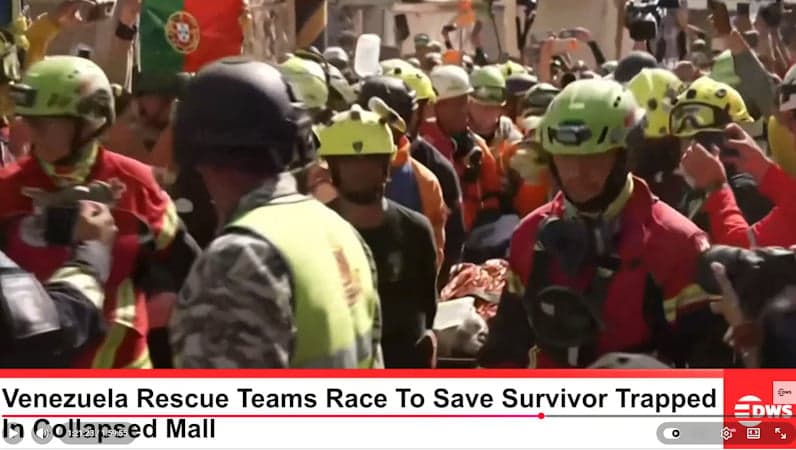
Rescuers pull a survivor from rubble eight days after devastating earthquakes strike Venezuela, as casualties mount across the nation.
A Miracle in the Ruins
CARACAS — Shouts of “¡Silencio!” echoed across the choked, dust-filled streets of La Guaira today as international urban search and rescue teams froze in place. Beneath a collapsed three-story apartment complex that had been reduced to a chaotic sandwich of concrete slabs and twisted rebar, an acoustic sensor had caught something impossible: a faint, rhythmic tapping. Hours later, through a combination of delicate hand-digging and hydraulic bracing, rescuers pulled a 42-year-old man into the harsh Caribbean sunlight.
He had been trapped in total darkness for eight days.
Hoy celebramos la vida de Hernán Gil. Gracias a los rescatistas nacionales e internacionales que pusieron su cuerpo, su tiempo y su alma en esta misión. pic.twitter.com/vSSFeNe6Jy
— Delcy Rodríguez (@delcyrodriguezv) July 2, 2026
Después de más de 100 horas de trabajo sostenido, Hernán Gil fue rescatado con vida de
Celebramos la grandeza del ser humano cuando se une por un solo fin: salvar a otro. ¡Gracias a nuestro rescatistas y al apoyo de los rescatistas internacionales! pic.twitter.com/PJiXoa2eKo
— Delcy Rodríguez (@delcyrodriguezv) July 2, 2026
The rescue of the survivor, whose identity has been withheld while he undergoes intensive emergency medical evaluation, has injected a profound wave of hope into an otherwise grim and exhausting race against time. Standard seismic rescue protocols dictate that the “golden window” for finding survivors closes after 72 hours. Yet, deep within structural voids where pockets of air and residual moisture linger, human resilience continues to defy the clock. Over 2,000 emergency personnel from 27 countries, alongside 160 specialized search dogs, are refusing to call off the search, continuing to meticulously comb through flattened neighborhoods across north-central Venezuela.
The Day the Earth Split
The current humanitarian crisis was triggered on June 24, 2026, at approximately 6:00 PM local time—on a national holiday when most citizens were gathered at home. In a rare and violent geological phenomenon, northern Venezuela was struck by two massive earthquakes just 39 seconds apart. The U.S. Geological Survey recorded a magnitude 7.2 foreshock followed immediately by a devastating magnitude 7.5 mainshock.
The epicenters were concentrated along the volatile San Felipe–Yumare–Montalbán axis, sending violent shockwaves ripping across the Caribbean coast and straight into the dense metropolitan valley of Caracas. It marks the most powerful seismic sequence to hit the country in more than 125 years.
The dual nature of the quakes meant that buildings compromised by the first tremor were brought down by the second, trapping thousands beneath heavy concrete structures. In the days since, the ground has refused to settle; more than 782 aftershocks have rattled the region, including a nerve-wracking magnitude 5.2 tremor that sent rescuers fleeing from unstable structures early this week.
Quantifying the Devastation: Casualties and Displacement
As emergency teams reach previously isolated parishes, the true human cost of the twin disasters is coming into focus. According to the United Nations Office for the Coordination of Humanitarian Affairs (OCHA) Situation Report, the official toll has risen significantly as recovery operations scale up:
- Fatalities: 2,295 individuals are confirmed dead, with authorities warning that this number will climb further as major structural clearances continue.
- Injuries: 11,267 people have been documented with injuries, ranging from severe crush syndromes to complex fractures and lacerations.
- Displacement and Homelessness: 12,841 people have been officially categorized as displaced and severely affected, their homes either entirely destroyed or rendered fundamentally unsafe by structural compromise.
In total, OCHA estimates that more than 26,403 citizens have been directly impacted by the physical or psychological fallout of the catastrophe. Across the seven states bearing the brunt of the damage, thousands of families are currently spending their nights outdoors. Fearing catastrophic building failures from continuous aftershocks, survivors have transformed public squares, schoolyards, and sports complexes into makeshift tent cities.
A Health System under Siege
The consequences of the disaster are placing an intolerable strain on an already fragile public infrastructure. The Pan American Health Organization (PAHO) and the World Health Organization (WHO) have issued urgent alerts regarding the state of the local healthcare network. Assessments across the affected regions reveal that 38 health facilities have sustained damage. Of these, several remain in critical condition or are completely non-functional, leaving surviving hospitals overwhelmed by an immense backlog of urgent surgical cases.
Beyond immediate trauma care, humanitarian organizations are tracking secondary public health threats. Ruptured water networks and compromised sanitation systems in temporary shelters have created a dangerous breeding ground for disease. PAHO has highlighted a heightened risk of vaccine-preventable and vector-borne outbreaks—including dengue, measles, and malaria—compounded by low pre-quake vaccination coverage and a critical shortage of medical personnel on the ground. To counter this, a 47-metric-ton emergency shipment from UNICEF containing water purification tablets, health kits, and emergency medicines has arrived to support affected communities over the coming months.
Local Resilience and Global Solidarity
Amidst the structural ruin, stories of profound local solidarity are emerging. In Caracas, members of the local community have quickly organized to provide sanctuary. Roberto Mishkin, president of the Union Israelita de Caracas, detailed how the country’s small Jewish community immediately mobilized, opening synagogues and the Hebraica community center to shelter hundreds of terrified neighbors whose residences were damaged or deemed unsafe. Volunteers have worked around the clock to distribute blankets, clean water, and hot meals to displaced families.
International aid agencies are also moving aggressively to close the supply gap. World Vision staff on the ground are working with local partners to deliver emergency shelter kits and psychological first aid to traumatized children. “We are deeply shaken and frightened,” noted María Andreína Pernalete, a Caracas resident and communications manager for World Vision, who had to flee her own building due to severe structural cracking. “We are praying for the families who are suffering, but we are also acting.”
The road ahead for Venezuela is immense. UN Resident and Humanitarian Coordinator Gianluca Rampolla emphasized that the immediate priority remains the extraction of anyone still holding onto life in the rubble, alongside the rapid expansion of organized transitional camps. With a tropical wave threatening to bring heavy torrential rains to the affected states, the race against both time and nature continues at a furious pace.
Sources and Links:
- UN Office for the Coordination of Humanitarian Affairs (OCHA) via ReliefWeb Earthquakes in Venezuela: Situation Report No. 8 (01 July 2026)
- United Nations News (UN News) Venezuela earthquake death toll passes 1,700 as UN continues to scale up response; Venezuela quake: Key services crippled and health workers missing
- Pan American Health Organization (PAHO/WHO) PAHO Response to the 2026 Venezuela Earthquakes
- World Vision 2026 Venezuela earthquakes: Fast facts, FAQs, and how to help
The post by SouthFloridaReporter.com appears on South Florida Reporter.
VIP Journal Media