As America gets set to celebrate its historic 250th birthday, a heat dome will trap the country’s birthplace under extreme, potentially record-setting conditions.
As America gets set to celebrate its historic 250th birthday, a heat dome will trap the country’s birthplace under extreme, potentially record-setting conditions.
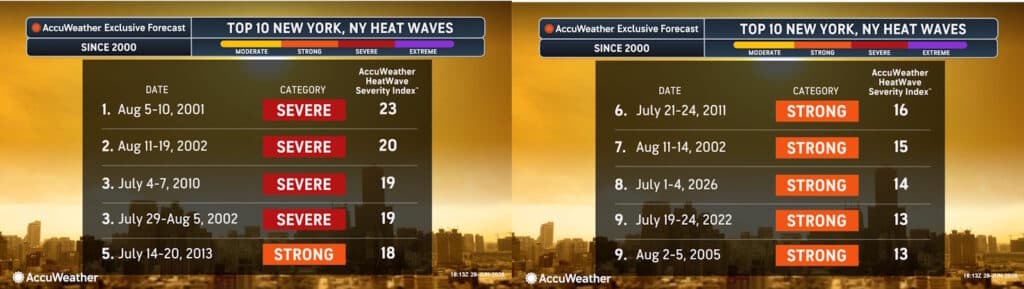
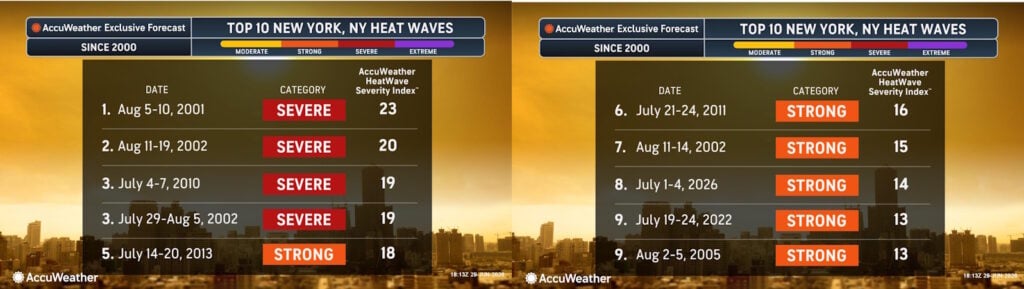
Philadelphia and New York will be prominently featured this week during America250 celebrations, and will both be under extreme conditions. The AccuWeather HeatWave Severity Index™, which factors in duration and intensity of these types of events, can compare heatwaves over time and forecasts this week’s ‘Fourth of July Week Furnace’ to be one of the ten most severe in New York City since 2000.
“For many Americans, the heat is already here. However, in many cities and communities, the hottest days are still ahead. As temperatures and AccuWeather RealFeel Temperatures continue to climb through the week, it’s important to take the heat seriously by limiting time outdoors during the hottest part of the day, staying hydrated and checking on those most at risk for heat-related illness, including the elderly, children and pets,” said AccuWeather expert meteorologist Carl Erickson.
New York City The last time it reached 100 degrees in Central Park was July 18, 2012, when temperatures reached 100 degrees
- The longest streak of days of 100 degrees or higher in Central Park is 3 days, which occurred in August of 1948 and July of 1993
- The most intense heat wave in our records in New York City occurred between Aug. 24, 1953, and Sept. 4, 1953 (12 consecutive days), which had an AccuWeather HeatWave Severity Index™ of 36
- This could be worst heatwave in New York City since 2013, which had an AccuWeather HeatWave Severity Index™ of 18 (Strong). The AccuWeather HeatWave Severity Index™ for this heat wave is 14 (Strong).
Philadelphia
- AccuWeather HeatWave Severity Index™ rate’s this heat dome heatwave a 21 this week in Philadelphia
- Since 2020, here have been six heat waves with an AccuWeather HeatWave Severity Index™ of 21 or higher, the most severe of which was an eight-day heat wave starting on July 19, 2022, which had an AccuWeather HeatWave Severity Index™ of 29
- The most intense heat wave in our Philadelphia records occurred between July 23, 1999, and Aug. 7, 1999 (16 consecutive days), which had an AccuWeather HeatWave Severity Index™ of 44
- Since the summer of 2010, Philadelphia has experienced a heat wave (defined by AccuWeather as three or more consecutive days with temperatures at or above 90 degrees) 11 times around the Fourth of July holiday. The most recent was July 4-10, 2024.
AccuWeather Heatwave Counter and Severity Index™
The exclusive AccuWeather HeatWave Counter and Severity Index™ measures heat waves by duration and intensity. Heat waves are defined as three or more consecutive days in which the temperature exceeds a location-specific threshold. In New York City, Chicago and Philadelphia, this threshold is set at 90 degrees Fahrenheit. In Raleigh, this threshold is set at 95 degrees Fahrenheit. The severity depends on the duration of the heat wave and the extent to which temperatures exceed the threshold.
The post by AccuWeather.com appears on South Florida Reporter.
VIP Journal Media