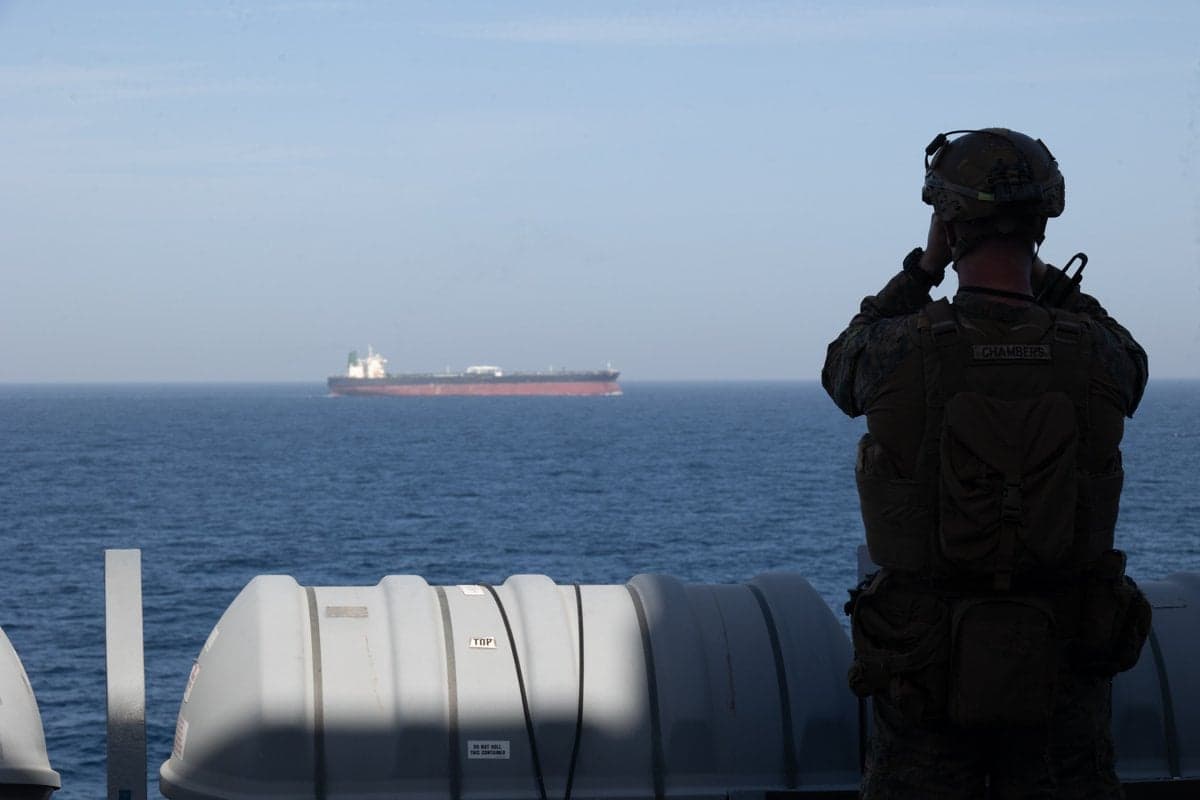
President Trump warns Iran against ‘blackmail’ as Revolutionary Guard gunboats fire on commercial tankers, forcing a total maritime shutdown.
WASHINGTON / TEHRAN — The fragile stability of global energy markets was shattered Saturday as the Islamic Revolutionary Guard Corps (IRGC) reimposed a total blockade on the Strait of Hormuz, reversing a 24-hour reopening and reportedly opening fire on several commercial vessels. The escalation comes at a critical juncture in the ongoing conflict between the United States and Iran, which began in late February 2026, and threatens to derail high-stakes peace negotiations currently being facilitated by Pakistan.
The Indian tanker captain in the Strait of Hormuz explodes in anger over the radio, confronting the Iranian Revolutionary Guard boats:
“You gave me clearance to pass!
My name is listed as number 2 in your papers!
Now you’re firing on me?!
Give me a chance to turn around and go… pic.twitter.com/hASNAxvFUM— سيف الدرعي| Saif alderei (@saif_aldareei) April 18, 2026
In the Oval Office on Saturday afternoon, President Donald Trump addressed the situation with a mix of defiance and cautious optimism, characterizing Tehran’s decision to close the waterway as a tactical error. “Iran got a little cute by closing the Strait again,” Trump told reporters during a briefing. “They wanted to create leverage, but they can’t blackmail us. We’re taking a very tough stand, and we have the most powerful military in the world watching every move.”
Despite the bellicose rhetoric, the President suggested that diplomatic channels remain active. “We’re talking to them. The talks in Islamabad are actually working out really well, believe it or not. We’ll have more information by the end of the day,” Trump added, hinting at a potential breakthrough even as naval skirmishes were reported near the Omani coast.
Chaos at the Chokepoint
The day began with reports from the United Kingdom Maritime Trade Operations (UKMTO) center stating that multiple merchant vessels had been harassed by fast-attack craft of the IRGC Navy. According to maritime intelligence firm TankerTrackers.com and MarineTraffic data, at least two Indian-flagged vessels were forced to reverse course after coming under direct fire.
The supertanker Desh Garima, carrying Iraqi crude, was among the few vessels that managed to transit the Strait before the full closure was enacted. However, at least four other Indian vessels—including the oil tankers Sanmar Herald, Desh Vaibhav, and Desh Vibhor, along with the bulk carrier Jag Arnav—were forced to turn back after IRGC gunboats reportedly fired warning shots and, in one instance, a projectile that damaged containers on a passing vessel.
“The situation is extremely fluid and dangerous,” a spokesperson for the Shipping Corporation of India (SCI) stated. “We have 14 vessels currently held in the Persian Gulf or the Sea of Oman, waiting for clear security guarantees that are not currently being provided.”
The IRGC’s joint military command issued a formal statement Saturday night, declaring that “control of the Strait of Hormuz has returned to its previous state under strict management.” Tehran has tied the reopening of the waterway directly to the cessation of the U.S. naval blockade of Iranian ports, which has effectively choked off the country’s economy since the war’s inception on February 28.
The Shadow of the February War
The current crisis is a direct continuation of the “Hundred-Day Conflict” that ignited earlier this year. The war began with a massive joint U.S.-Israeli air campaign on February 28, 2026, which reportedly resulted in the death of Iran’s Supreme Leader, Ayatollah Ali Khamenei, in the opening hours of the strike. Since then, Iran has been led by a fragmented domestic coalition, with the Supreme Leader’s son, Mojtaba Khamenei, largely out of public view, fueling intense speculation about a power struggle in Tehran.
For the Trump administration, the strategy has been one of “Total Blockade.” Unlike the “Maximum Pressure” campaign of his first term, which relied on financial sanctions, the 2026 strategy involves a physical naval blockade. U.S. Central Command (CENTCOM) confirmed on Saturday that American forces have turned back 21 ships attempting to enter or exit Iranian ports since Monday alone.
“The blockade will remain in full force until we have a signed, verified deal that addresses the nuclear program and the maritime aggression,” Trump emphasized on Saturday. “Maybe I won’t extend the ceasefire next week. If we don’t get a deal, unfortunately, we might have to start dropping bombs again.”
The Islamabad Negotiations
The focal point for a potential resolution remains Islamabad, Pakistan. Pakistani Foreign Minister Ishaq Dar has been shuttle-diplomating between U.S. representatives and an Iranian delegation led by Foreign Minister Abbas Araghchi and Parliament Speaker Mohammad-Bagher Ghalibaf.
Sources close to the talks suggest that the primary point of contention is Iran’s stockpile of 60% enriched uranium. President Trump has publicly claimed that Tehran has agreed to relinquish its nuclear material, a claim that has sparked a firestorm of controversy within Iran. Hardline factions in Tehran, including members of the National Security Commission, have denounced Ghalibaf and Araghchi, with some even calling for their arrest for “treasonous concessions.”
Ebrahim Azizi, head of the Iranian parliament’s National Security Commission, stated Saturday that the Strait is “returning to the status quo,” which requires all commercial ships to seek Iranian naval authorization and pay a transit toll—a condition the U.S. has flatly rejected as illegal under international maritime law.
Economic and Regional Ripples
The closure has sent shockwaves through global energy markets. Oil prices, which had begun to stabilize following a brief reopening of the Strait on Friday, surged by nearly 8% following the reports of firing on tankers. Analysts at Kpler warned that a prolonged closure could push crude prices toward $150 per barrel, potentially triggering a global recession.
The conflict is also deeply intertwined with the situation in Lebanon. On Saturday, the Israeli military announced it had established a “Yellow Line” demarcation in southern Lebanon, a buffer zone designed to separate its forces from Hezbollah remnants. The establishment of this line is seen by some as a prerequisite for a broader regional ceasefire, though the escalating naval war in the Persian Gulf threatens to overshadow any progress made on the Levantine front.
A Tense Countdown
As the temporary ceasefire is set to expire mid-next week, the international community is watching the Gulf of Oman with bated breath. The U.S. 5th Fleet, based in Bahrain, has increased its patrol frequency, though it has so far avoided direct kinetic engagement with IRGC gunboats to prevent a full-scale naval war.
“We are at a point where a single miscalculation by a gunboat commander could lead to a catastrophic escalation,” said a maritime analyst for the Middle East Forum. “Trump is betting that his blockade will break the Iranian economy before the IRGC can break the global energy supply. It is a high-stakes game of chicken with the world’s economy as the stakes.”
For now, the Strait of Hormuz remains “strictly managed” by the IRGC, the tankers are turning back, and the world awaits the “information” President Trump promised would be revealed by the end of the day.
News Sources Used and Links:
- PBS News: Iran’s military closes Strait of Hormuz again, citing U.S. blockade
- The Hindu: Iran-Israel war LIVE: Iran fully closes Strait of Hormuz over U.S. blockade, fires on ships
- The Times of Israel: Trump: ‘Iran got a little cute’ by closing Hormuz again; ‘they can’t blackmail us’
- Al Arabiya: Trump says Iran cannot ‘blackmail us’ with Strait of Hormuz
- The Guardian: Trump news at a glance: president celebrates strait of Hormuz reopening, though Iran officials warn they could close it again
- Middle East Forum: Strait of Hormuz Tensions Escalate Despite Trump’s Upbeat Tone
- Interlochen Public Radio (NPR/AP): Iran says it has closed the Strait of Hormuz again, as ceasefire nears its end
The post by SouthFloridaReporter.com appears on South Florida Reporter.
VIP Journal Media