Most scissors are made to work best for right-handed people. Special reversed scissors for left-handed users are available.
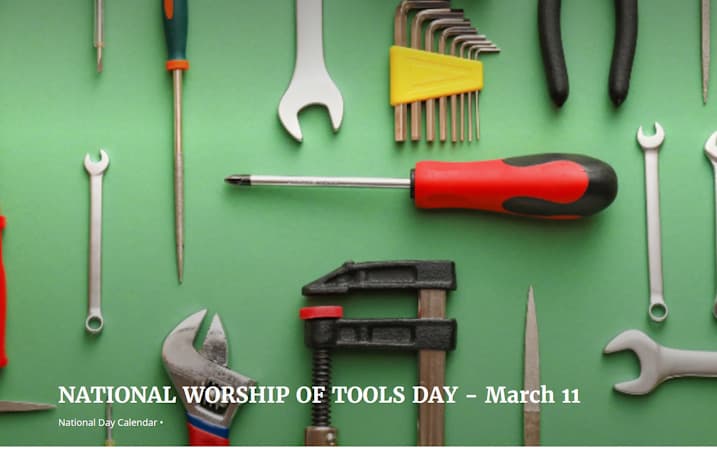
March 11th is National Worship of Tools Day. This is a day to go out into the garage, the tool shed, the storage closet or wherever it is you keep your tools. You can clean them, reorganize them, make something new with them or maybe go to the store and buy a new one.
- 3.4 Million Years ago – Animal bones from Dikika, Ethiopia, dated to roughly 3.4 million years ago, bear cut and percussion marks that indicate Australopithecus afarensis used stone tools to process meat and marrow, revealing tool use far earlier than once thought.
- 3.3 Million Years ago – Archaeologists uncover intentionally knapped stone tools at Lomekwi 3 in Kenya, pushing the origin of toolmaking back to about 3.3 million years ago and showing that hominins were shaping stones long before the genus Homo appeared.
- 2.6 Million Years ago – At sites such as Gona in Ethiopia, archaeologists find Oldowan stone tools dating to about 2.6 million years ago, representing the earliest widely recognized stone tool industry and a key milestone in technological and cultural evolution.
- 1.76 Million years ago – Acheulean technology emerges with large, teardrop-shaped handaxes and cleavers that show symmetry and planning, reflecting advances in skill and cognition among early humans compared with earlier, simpler toolkits.
- 3300 BC – As societies in regions such as the Near East enter the Bronze Age, copper alloyed with tin yields harder bronze tools and weapons, revolutionizing farming, craft production, and military power compared with stone implements.
- 1200 BC – With the rise of iron smelting and forging, iron blades, plowshares, and hand tools become increasingly common from Anatolia to Europe, offering stronger and more durable implements that support population growth and expanding agriculture.
- 13th Century – Ancient blacksmiths invented steel by combining iron with charcoal, making it harder and stronger.
- 1400s – The screwdriver can be traced to the 1400s
- 1761 – Cast metal scissors, much like the ones we use today, are produced.
- 1818 – The first milling machine was invented in the US in 1818 by the manufacturer Simeon North, whose role was also significant in the development of interchangeable parts.
- 1891 – Karl Elsener begins producing the Swiss Army Knife in Switzerland.
- 1895 – The first electric hand drill was invented in 1895 in Germany.
- 1916 – Black & Decker added a pistol grip to the electric drill, allowing one person to drill without another person’s help.
- 20th Century – Tool chests enter the world of mass marketing.
- Hand tools can be categorized as wrenches, pliers, cutters, files, hammer tools, screwdrivers, vises, clamps, snips, saws, drills, and knives.
- A version of the game “Rock, Paper, Scissors” was originally called “Knife, Fork, Spoon.”
- Tools can be classified as measuring tools, holding tools, cutting tools, driving tools, and electrical tools.
- The inventor of the first portable saw wanted to find a better way to cut sugar cane than the traditional way with a machete.
- Modern cutting pliers cannot be sharpened.
- The plural of scissors is still scissors.
- A drilling machine is regarded as the most important power tool.
- If the pivot of the scissors is closer to the blade end and further from the handles, the cutting power of the scissors is greater
- Most scissors are made to work best for right-handed people. Special reversed scissors for left-handed users are available.
- Tools discovered in Kenya in 1969 are estimated to be some 2.6 million years old
- Tool specialization for agriculture may have begun as long as 10,000 years ago
- Humans developed tools, like chisels and saws, approximately 4,000 years ago
- Tool chests have been prevalent in America from the earliest days of our founding.
- Union Tool Chest Company – made tool chests for machinists
- Sears Craftsman – offered tool chests for machinists and more casual users
- Stanley – produced tool chests with a design similar to steamer trunks
- McCormick, John Deere – made tool chests for farmers to mount on their tractors
- Snap-On – a brand of toolboxes made for auto mechanics
- A worker at a sewing machine manufacturer replaced the needle with a long, thin saw. That was the beginning of the jigsaw.
- At what speed does a nail travel as it leaves a nail gun? 1400 feet per second; therefore, safety is extremely important when using a nail gun.
- Milwaukee Tool Was The First Tool Manufacturer To Use A Lithium-Ion Battery.
Tool Humor
Sources:
Tool Storage Help
The post by SouthFloridaReporter.com appears on South Florida Reporter.
VIP Journal Media
Потрібні Преміум Медіа-послуги?
Веб-дизайн
Ідентичність Бренду
Друковане Виробництво
Переглянути ПослугиНам довіряють провідні бренди Південної Флориди